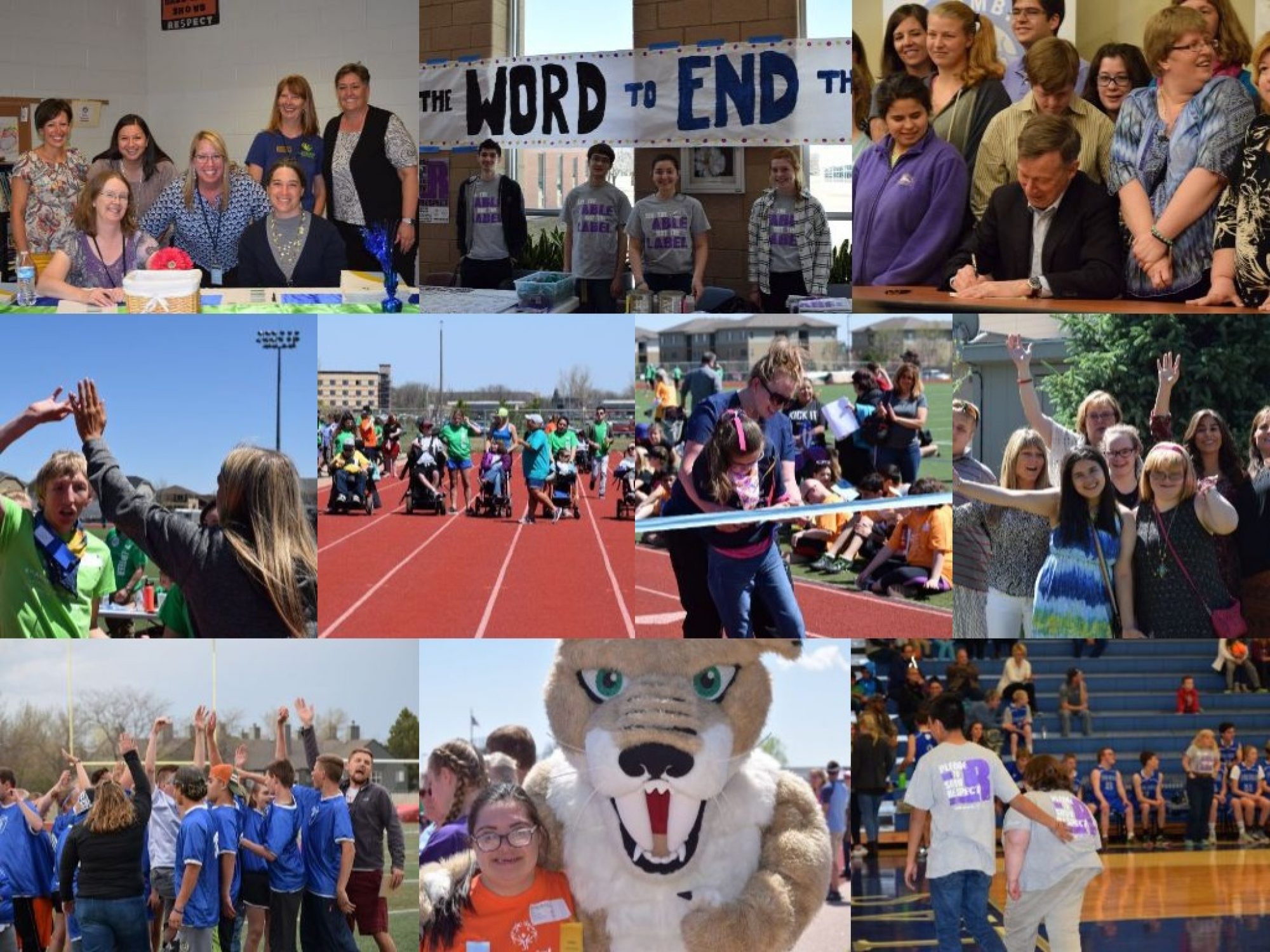

As inclusion week wraps up its good to think through what inclusion means to you. Inclusion is not limited to schools, but it is generally where we devote the most time and energy. By definition, inclusion is the act of including or the state of being included. That’s a pretty subjective standard. Poudre School District staff and students were asked what inclusion means to them. Here are some of their answers:
- To me, inclusion means that every student is thoughtfully planned for, purposeful in their environments, and valued as a part of the community. I also believe that inclusion can be felt, like a warm fuzzy hug – you know when you walk into an environment where ALL students are active and meaningful in what they are doing.
- Giving each student what they need so that they can learn together.
- Teaching students that it is okay to be different and to be themselves.
- Truly supporting students in the least restrictive environment.
- Helping to develop self-advocacy and disability advocacy skills.
- Making friends.
- Being exposed to lots of things I can be good at.
- Not judging people based on what they can or can’t do.
- Working with everyone no matter their abilities and forming friendships with all groups.
- I love to be with my friends and to communicate with each other.
- Coexisting in an environment where everyone is considered equally.
- Connecting with others seeing their strengths not their challenges.
- Being included and accepted, treated no different than everyone else.
- It is an everyday practice. It is truly nothing special at Preston. Inclusion means collaboration. To do it well we have to work closely with peers and staff.
- Preston does a good job with inclusion. There are not any classes where students are not included. There is not a stigmatism or labeling as different. I don’t even think the kids realize it is happening.
So, what does inclusion look like in a school environment? Laura Osborn

from Rice Elementary School explained, “At Rice, students in the ILS program are included in their general education setting as much as possible. While they are not in there the entire day, we make the times that they are in there meaningful. I conference with their general education teachers in order to provide modifications of curriculum when needed, and to provide materials that are appropriate for that student. We send students to class with support so that they can have more direction in the classroom. Our grade level teachers are amazing about setting the tone and culture of their classrooms. They teach their students that everyone is valued, and everyone can contribute. That sets the basis for our students coming in, who may do things a bit differently. Their peers view them as equals, and love to share their successes with us.”

Preston Middle School has multi categorical programming, supporting a wide variety of student needs, which allows for a good amount of support from within a general education classroom. “Our goal is to making sure students are viewed by peers positively and that they are able to work to their best ability in class,” shared multi-categorical, Integrated Services teacher, Amy Cesar.
Inclusion is the product of collaboration and hard work on the part of all educators who are involved. Inclusion is made successful by modifications, adaptation and acceptance.
Check out this great read from Renee Ostergren on inclusive competence.

Poudre School District Integrated Services Director: Sarah Belleau 2407 Laporte Avenue, Fort Collins, CO 80521
 Integrated Services’ social worker Derrick Searle and
  she understands the stress and pressure of being a teenager. The student leaders that make up PHS Ambassadors are a trained group who provide underclassman resources and support with whatever they are going through. The group tackles hard topics such as managing stress, sexual assault prevention and teen dating violence. “I love that instead of it just being a conversation for my age group, it is open to the community to help and hopefully alleviate some of the stigma that goes with mental illness,” says Ayushi regarding the event.
 At birth, Libby’s complications were more significant than her brother’s. However, at 5 weeks of age, James suffered a stroke which left him with extremely high muscle tone and the inability to communicate verbally, among other complications. Libby and James share a unique and special bond as twins. She understands James and what his needs are, enabling her to help when there is a necessity. “I feel like he’s my age but I still watch over him more,” she shared. Twin life for Libby isn’t all unity all of the time. Like many siblings close in age, they argue and have a little sibling rivalry. Over the years, Libby’s parents have instituted different “birthdays” so that each has the opportunity to be celebrated as an individual.
 She refuses to view things that do not work out as failures but instead as a learning opportunity. For example, after a season of basketball she found that she just didn’t have the speed required to keep up with her peers. Instead of being discouraged by that, she smiled and chose to look forward to her next possible adventure. There is no doubt that she is already achieving her goal of inspiring both young and old alike.
 Integrated Services Poudre School District